 Subscribe
Blog
-
how to use a sewing pattern
8:16 AM PST, 8/28/2009
hey y'all...i have to say that i really like to sew...i'm one of those people that can pretty much look at something and make it...there's only one problem with it...i don't know how to read/use a pattern...i've only tried once before now...i wanted to make a purse and i couldn't for the life of me figure it out so i found and bought the pattern...how hard could it be...right...oh my god...how hard could it be...i cut the pattern out...pinned it...so far so good...cut my fabric...i was movin' right along...until...i started readin' the instructions that came with it...it starts talkin' about notions, selvage edges, tracin' wheel, pattern weights, as well as the pattern itself is covered with all kinds of arrows, dots, lines, etc...needless to say i was so lost i didn't think i was ever gonna find my way back...i stopped readin' the instructions and decided to put the purse together...i have to say it turned out pretty cute...so cute i made a few for my cousins to use along with matchin' flip flops...i promised myself i wouldn't ever put myself through the dreaded pattern hell again...i love to look/read cookbooks and patterns...i know...right; patterns...but i still love to look through them...i saw the cutest little quilt and i would need the pattern to cut out the pieces...i told myself that i could do it...i wasn't gonna let it get me...so i bought another one....i'm tryin' not to stress out but, i'm still lost...i'm just gonna put down the booklet and walk away...i used to think it was awesome to look at it and make it...i'm thinkin' it's not all that now....i done a search on how to use a pattern however, it was more about the basics which i already knew...i've seen my mom use them :)...oh well...i'm sure i'm not the only one out there that can't read a pattern so i thought i'd pass along what i found
- Choose a simple pattern for a first-time sewing project that has few seam lines and few pattern pieces. Also look for an easy-fit or looser garment style. Don't try anything that has to be lined with another fabric.
- For sewing your first pattern, don't buy expensive fabric because you may not be able to fix mistakes.
- Read the user guide (sheet) before starting the project...good luck :p
- Have a good sewing book such as the "Reader's Digest Guide to Sewing" or other well known text on the subject. Vintage and older publications are fine too...what...i didn't know there was a book that could help me...i'm gonna have to get one :0p
- Double-check measurements, seam allowances, and needle-type for your fabric. Not all sewing machine needles are the same.
- Determine the right side and wrong side of the fabric. The wrong side is the fabric worn against the body once the garment is completed. Use a pin to mark the wrong side of the fabric.
- Also determine the grainline or direction of the fabric: locate the selvage edge. The term 'nap' refers to the up-and-down nature of a print (could the design be cut upside down by accident?)
- Some easy sewing patterns are available from most major sewing companies. Some major sewing pattern companies include Kwik Sew, Butterick, Simplicity and McCall. These patterns are clearly marked 'easy' and can be found at almost any Walmart or fabric store...good luck and happy sewin' ;p
- Select an easy pattern with a small number of pattern pieces. Read the pattern envelope to help select the appropriate fabric and notions (sewing supplies) needed for the sewing project. Buy the correct size by having a friend measure you first. Don't buy the size you get ready-made clothing in. Pattern sizing is very different. Look on the back of the pattern envelope and determine your size by the 'finished' measurements.
- Open the envelope and read the directions. Find each pattern piece that you will need to use and cut it out. Pin the pieces together using 5/8" seam allowance. Make sure you double-check the seam allowance in the pattern because not all patterns use 5/8". You will have 1/2 of the garment. Have a friend check the fit and help you make any needed alterations in size or length.
- Read the pattern user guide (sheet) to determine the sewing patterns' layout on the fabric. Be sure you understand the grainline of your fabric--this is the same as the direction of the selvage edges. Also check your fabric print to see if any images will be upside down.
- Layout the patterns according to the user guide.
- Pin the pattern pieces to the fabric following the user guide. You can also use pattern weights so you won't damage fine/delicate fabric with your needles.
- Use a pair of scissors specifically earmarked for cutting out paper sewing patterns. Keep another pair of 8" long scissors specifically earmarked for cutting out fabric. Sewing patterns tend to dull scissors and sharp scissors are needed to easily cut fabric. Cut the fabric using the pattern pieces as a guide.
- Mark the patterns using tailors chalk or a tracing wheel and tracing paper. You can also make tape labels for the back of each pattern piece so you won't get confused when you start to sew and don't know what you are looking at.
-
an awesome frugal living tip on how to make your razor blades last longer
4:58 PM PST, 8/25/2009
Anyone who shaves may want to know how to stretch the use of their razor blades. Here are a few interesting pointers
People try all kinds of tricks to make razor blades last longer, including storing them in oil or even placing them on a prism to channel pyramid power into the blade. However here is a simple technique that seems to work: dry the blade after use. According to the Chicago Tribune, the concept is this: razor blade dullness stems more from oxidation and microscopic rusting, rather than from contact with whiskers. Water that sits on blades between shaves causes the oxidation. Corrosion can cause metal on the blade to flake off and the edge to become blunted and jagged. That results in blades pulling and tearing hairs instead of cleanly slicing through them.
By blotting his blades on a towel after use, someone extended the use of a blade from ten days to five months.
Or you can also “rinse the razor in water, shake excess droplets, dip it in alcohol, give it a good swirl (it really does clean far more thoroughly than water), then shake out and prop it in its holder. The alcohol drives the water out and then quickly evaporates.”
-
help my soap is disappearing
8:25 PM PST, 8/24/2009
is there anything i can do to make my bar of natural soap last longer?
yes...simply use a soap dish with ridges that allows the soap to dry between each use...your natural soap will last up to 50% longer...don't let the soap set in the bath water while your using it...store unused soap in a cool, dry place as the heat and humidity of your shower can and will evaporate your soap away
why don't i get that squeaky clean feeling when i use your MP soap bases?
no worries all is great!!!...i couldn't be happier that you don't get that feeling when you use my MP soap bases :)...why you ask...because that squeaky clean noise you get rubbing your hand over your skin means that the detergent ridden commercial soap you've been using has taken all the natural moisture out of your skin....healthy, clean skin is not naturally squeaky....one can only hope you remain "squeakless"! :p
i hope this helps and if i can help you with anymore ?'s just let me know and i'll do my very best to get the most helpful answers to you...thanks so much...crystal...remember to always smile, have fun, and say something nice to a loved one :0)
remember to check out all of my blog for more helpful hints, tips, and tricks
-
broom superstitions...interesting and fun
8:05 AM PST, 8/21/2009
broom superstitions
a broom dropping in front of the door means company before the day is over
always pick up, for luck, a brom that is lying on the floor or ground
always sweep dirt out the back door or you will sweep away your best friend
bad luck will befall you all year, if you sweep on new year's day
burn up the rubbish when you sweep on new year's day and you'll have money throughout the new year
carry a broom under your arm for luck
carrying a broom over your shoulder will give you bad luck
don't sweep immediately after the departure of a guest or you'll sweep him bad luck
dropping a broom while sweeping is the sign of new carpet
hitting someone with a broom means he'll go to jail before the week has passed
if a broom falls as you're passing it, you'll have bad luck
if a broom falls in front of you and you step over it before picking it up, you'll have a "bed of sickness"
if dirt is swept out a door before sunrise, you may expect bad luck
if dirt is swept out of the house on friday, the house will burn
if someone comes in to see you and you pick up a broom and go to sweeping in fron of them, that is the sign they're not wanted and you want them to go
if you go to someone's house and have to step over a broom, it shows that the mistress of that household is an untidy housekeeper
if you hand a broom through a window to someone, you may expect bad luck
if you must borrow a broom, take it without the owner's knowledge, and you'll not have bad luck
if you must sweep on new year's day, you can avert bad luck by not taking up the dirt and leaving it in a pile on the floor
if you must sweep your kitchen after sunset, you can avert bad luck by burning the dirt
if you step over a broom you'll be arrested
if you sweep after dark you'll bring sorrow to your heart
if you sweep after dark, you'll sweep out the money made that day
if you sweep in front of someone, you're sweeping them off the earth
if you sweep under someone while their sitting in a chair, you're giving them bad luck
it causes bad luck to sweep a porch after dark
it's a sign of good luck to have a broom drop in front of you
it's a sign of misfortune, to lay a broom on the bed
it's unlucky to borrow a broom
it's unlucky to sweep on monday
it means bad luck when a broom falls across the derail
keep the corners of your broom square or even for luck
lean a broom against a bed and you'll be unlucky
let the broom rest with the straws up and you'll be lucky
letting the sweeping edge of a broom wear off at the two corners will bring you bad luck
never burn a broom; it'll bring you bad luck
never sweep dirt out the front door; it'll bring you bad luck
never sweep the kitchen after supper, whether daylight or dark, or you'll sweep out all your money
never sweep your kitchen early in the morning before sunrise, or you'll be unlucky
stepping over a broom will bring sorrow to your heart
stumbling over a broom handle will bring you good luck
sweep after dark and you'll never be rich
sweep on the third day after easter and you'll have bugs in your house
sweep the top of a bed and you'll have bad luck
sweeping dirt over a doorstep after 6:00pm will bring bad luck
the child who steps over a broom will get a whipping
to brush your boot with the broom while you're sweeping will give you bad luck for a week
to have good luck, place the broom on its handle in a corner
when a small child takes a broom and begins to sweep, company is coming
-
what's wrong with my natural melt and pour soap base...how can i make my soap base harder?
7:43 PM PST, 8/20/2009
hey to all my blogger friends...today i was hit with the ?...what's wrong with my natural melt and pour soap base?...what's wrong indeed...could it be something you done?...where did you go wrong?...how could this have happened?...STOP!!!...maybe it could be nothing more than the natural MP soap base itself...perhaps it's nothing you done...perhaps you didn't do anything wrong...perhaps it's due to high content of coconut oil used in the natural MP soaps which makes it sweat and difficult to unmold...perhaps it's just that easy...the long and the short of it is...natural MP soap base can be somewhat of a pain to deal with...one must ask themselves is the benefit worth it or not...some say yes however, for those who haven't ever tried natural bases might just think different when trying to make their first bars...myself i don't like the stickiness of natural bases...i don't find it all that difficult to unmold...here in TN it gets very humid which in my opinion causes the natural bases to become very~very sticky...sweaty if you will...i will say in the natural MP soap bases defence i'm one of those people whom can't stand to get anything on their hands...that in itself could be my biggest problem with it...several people love the natural bases...you'll have to decide for yourself :p...i've done some searching trying to find out what if anything can be added to the different soap bases to make them harder...this is what i found...i'm not sure how well they work simply because i haven't tried them...if you choose to try any of them let me know what you thing and how well they work
Fats, oils and waxes are used to harden soaps. Beef or sheep tallow and pork lard have been used for years as the main fat ingredient for bar soaps. Tallow is the fat that has been rendered. Vegetable shortening and cocoa butter are used as well. Palm oil is also often preferred because it helps the batch to process quickly and to preserve well. Coconut oil and olive oil are also choices to harden soaps. Stearic acid is popular for hardening soaps and is found in tallow and palm oil or purchased separately. Another item that has been welcomed for its hardening quality is beeswax. Candelila wax and Bayberry wax can be used instead of beeswax, as can Jojoba oil since it has a wax structure which causes a batch of soap to thicken more rapidly.
remember...whether you use the "melt and pour" method or make soap from scratch, the main thing to use is good water. Distilled water is highly recommended because the additives in regular home drinking water could interfere with the soapmaking process.
-
how do i swirl the color in my melt and pour soap?
1:59 PM PST, 8/18/2009
how to swirl color in your melt and pour soaps
While I'm by no means an expert, I'll be glad to share what I've learned about swirling -- a process I love and which took me 8 pounds of M&P base and four weeks to sort of master -- at least get fairly consistent results.
For two colors, I melt M&P in to different containers. Cool until a skin forms, then add scent and stir the skin back in. If my stirring produces bubbles, then I spritz lightly with alcohol. I wait a few minutes (1-2 minutes -- trying to keep from messing with it), and stir one last time. I pour one color from one side of the mold, the second color from the other side -- slowly. As they meet in the middle of my mold, I spritz lightly with alcohol to keep them separate. Then I wait, do the swirling-waiting dance. When another skin forms, I remove this, THEN swirl gently with a knife or spoon to get my two colors to inter-face -- do gently or even this cool, they're apt to blend. That's it for two colors.
For three colors, someone (forgive me I'm terrible at remembering names -- sometimes even my own!) suggested making a triangle out of a medium-weight piece of cardboard to fit into your mold so that you have 3 compartments. After melting your base, scenting and coloring it, and after it cools and thickens (be patient here -- it takes a while -- the thickened-part is after a skin forms, after you stir this back in, and when the base gets a little like "just about to set up jello", then pour each into your cardboard-ed compartments. You can spray them with alcohol to keep the colors separate. Then I wait some more (this is when I was told one does the "swirling" dance - helps keep one's impatient fingers from messing things up -- again forgive my name memory loss). When another skin forms, stir this in. By now the base is getting thicker. You can at this point, remove the cardboard, and gently swirl the three colors together.
I also found that the type of mold I use makes a huge difference. The broader the mold versus the thicker the mold seems to work well. I add a bit of clear base to the white to "lighten it" some so that the swirling would work better.
This seems to work for me -- though I find that if I'm too impatient (which is often!), then my swirls won't look as nice. It really is the temperature (in my humble experience) and seems to keep the swirls a swirl and not a blend.
i'm not real sure who wrote this as it was sent to me and the person wasn't sure who wrote it either...oh well...i wasn't clever enough to come up with it...i am however; clever enough to pass it on to you as another way to make your soaps...good luck and happy soap makin' :p
-
The Soap Making Dictionary
12:35 PM PST, 8/7/2009
Aa
absolute~a concentrated alcohol solute aromatic base.separated from the fatty acids and waxes in a concrete using alcohol and vacuum distillation.
almond oil~obtained from the nuts, almond oil is used in skin care preparations as an emollient or as a carrier oil.
aloe vera~the juice or gel obtained from the leaves of this plant are used in cosmetics fr its soothing and healing properties.
anhvdrous~a liquid or a compound that does not contain water.
antioxidant~prevents or retards the reaction of a substance with oxygen.inhibits oxidation, the damage from free radicals.
apricot kernel oil~derived from the seeds, used in skin care preparations for its moisturizing properties.
aromatherapy~the use of fragrance or essences from plants to alter a person’s mental or emotional well being.
aromatic~having a strong fragrance or odor.
ascorbic acid~vitamin c.
astringent~constricts or tightens the skin, used in facial preparations, also removes oils from the skin.
avocado oil~obtained from the pulp of the fruit, avocado oil is high in unsaponifiables.used in cosmetics and skin care preparations for its moisturizing and nourishing properties.
awapuhi kuahiwi~hawaiian wild pinecone ginger or shampoo ginger.the thick, sudsy juice squeezed from the mature flower heads is used as a shampoo or hair conditioner.
Bb
balsam~aromatic resinous substances containing benzoic and cinnamic acid, such as balsam of peru.
beeswax~wax obtained from processing the honeycomb. used in candles, soaps, and lip balms.
biodegradable~able to be decomposed by biological agents, such as bacteria.
biopein~all natural preservative and stabilizing ingredient manufactured from a blend of botanical extracts.
bleaching~the process to remove or neutralize the color of an oil or fat.
borax~sodium borate, a white crystalline mineral generally used as an emulsifier or cleaner.
botanical~obtained from a plant or plants, related to plants or botany.
botanical name~the latin name assigned to distinguish one species from another, the scientific name composed of the genus followed by the species.
Cc
carrier oil~a vegetable or nut base oil used to dilute essential oils prior to the application on your skin.
castile~a region in spain known for producing olive oil based soaps in the 13th century. a soap with a large percentage of olive oil is referred to as a castile soap.
cosmetic~product applied to the human body for cleansing, beautifying, promoting attractiveness, or altering the appearance without affecting the body’s structure or functions.
cosmetic grade~refers to the approval for use in cosmetics, such as colorants, dyes or fragrance oils which will come into direct contact with your skin.
CPHP~crock pot hot process. a method of soap making utilizing the heat from an electric crock pot during the soap making process.
cruelty free~not tested on animals.
Dd
d&c~prefix used to drugs and cosmetics, such as d&c red #7.
DBHP~double boiler hot process. hot process soap making using a double boiler to apply heat during processing.
decoction~a tea or infusion brewed from hard plant material such as bark and roots.
deodorize~the process in which odoriferous matter is removed from an oil or fat.
detergent~a petroleum based surfactant other than soap. developed during WWII when soap making oils were scarce.
DHHP~direct heat hot process. hot process soap making utilizing externally applied heat processing.
DOS~dreaded orange sots. small dark orange spots radiating to yellow occurring on the surface of cold processed soap. the primary cause is thought to be unsaponified oils turning rancid.
DWCP~discounted water sold process. a cold process method of soap making utilizing a lower percentage of water in the formula for a stronger lye solution.
Ee
embeds~used in loaf, tube and column molds. soap embeds are of a contrasting color and shape such as moon and stars, curls ribbons.
emollient~an additive used to soften or soothe your skin. cocoa butter or shea butter are added to handmade soap as an emollient.
emu oil~refined from the fat of the bird, the oil is used in a variety of cosmetics for it’s skin nourishing properties.
emulsifying wax~used to combine oils with water when manufacturing lotions and creams.
emulsion~a stabilized blend of oils and water such as a lotion. the suspension of one liquid within a second liquid which normally do not mix.
enfleurage~the process of extracting the aromatic essences from plants using odorless fats to absorb the oils from flowers. the fat is then dissolved in alcohol to separate the essence from the fat and distilled to remove the alcohol.
EO~essential oil
epsom salt~hydrated magnesium sulfate. a white crystalline powder used in bath preparations and foot soaks. originally obtained from the mineral waters found in epsom, england.
essential oil~highly concentrated volatile oil extracted from aromatic plants, most commonly through pressing or steam distillation. used for fragrance and flavorings.
exfollant~an abrasive added to slough off dead skin cells. such as oatmeal or ground cinnamon.
expeller pressed~the process in which an oil is extracted from a base by mechanically crushing and pressing the material at temperatures less that 220 degrees fahrenheit.
Ff
FCC~food chemicals codex~the industry standard for listing food grade ingredients
FD&C~prefix used to designate the approved use in foods, drugs and cosmetics.
felting~encasing a bar of soap in a non~woven fabric made of unspun wool fibers matted together using heat and water.
fixative~used to anchor or stabilize a scent or fragrance, to slow evaporation.
fixed oils~the non~volatile oils obtained from botanical bases such as vegetable oils.
flash point~the lowest temperature that a liquid can form an ignitable mixture with air (vapor) near the surface of the liquid.
floral water~see hydrosol.
FO~fragrance oil.
formula~a listing of ingredients in fixed proportion, usually expressed in percentages.
fragrance free~contains no added fragrance products. there is no regulated definition for this term, and it is best to consult the ingredients list as some commercial fragrance free or unscented products contain a masking fragrance.
fragrance free~synthetic oils formulated to mimic natural fragrances. sometimes blended with essential oils.
Gg
germaben II~an oil and water soluble anti~microbial preservative used in personal care products.
glycerin~a triatomic alcohol (glycerol) byproduct created during saponification. used in food, cosmetics, soaps, and lubricants.
goat milk soap~cold processed soap made with fresh, previously frozen or powdered goats milk.
grapefruit seed extract~derived from the seeds and pulp, it used as a preservative in handmade toiletries. it is thought to have antibiotic and antiseptic properties.
GSE~grapefruit seed extract.
Hh
hand milled soap~soap fashioned through rebatching cold processed soap.
handcrafted soap~soap crafted from a ready made soap base using the melt and pour process. also used to refer to handmade soap.
handmade soap~soap fashioned by combining a base oil with an alkali using a variety of traditional methods including hot and cold processing.
hemp seed oil~obtained from viable or sterilized seeds, hemp seed oil is high in essential fatty acids that are easily absorbed by the skin. contributes moisturizing properties to soaps and cosmetics.
herb~an aromatic plant used in medicine or as a seasoning that does not produce woody tissue and usually dies back at the end of the growing season.
hot process~a method of soap making utilizing an external heat source to accelerate the saponification process, such as a crock pot, double boiler or oven.
humectant~a substance that attracts and holds moisture unto itself, such as glycerin.
hydrogenation~a chemical process of converting a vegetable oil from a liquid into a solid using hydrogen.
hydrolate~see hydrosol.
hydrosol~the condensate water produced during steam distillation of botanical bases when making essential oils. used in skin care preparations and bath products. also known as hydrolat or floral water.
hypoallergenic~unlikely to cause an allergic reaction.
Ii
INCI name~international nomenclature of cosmetic ingredients. the INCI name is required when labeling cosmetics marketed in the USA.
infusion~made by steeping botanicals in oil or water.
insoluble~not dissolvable in a liquid, such as water or alcohol.
irritant~causes irritation or inflammation of the skin.
Jj
jojoba oil~liquid wax obtained from the seeds. jojoba oil is used in numerous skin care preparations.
Kk
karite butter~see shea butter
kokum butter~also known as goa butter, extracted from the fruit kernels of the garcinia indica tree, native to india.
KOH~potassium hydroxide.
kukul nut oil~also known as candle nut oil, it is obtained from the fruit of the tree and used in skin care preparations. hawaiians have used kukui nut oil for generations to treat dry skin.
Ll
lanolin~wool fat, a fatty substance (wax) obtained from wool and used in soaps and cosmetics as a moisturizer.
lard~the semi~solid or solid fat rendered from a hog.
layering~the process of pouring multiple layers of soap, usually of varying colors.
loofa~the dried fibrous section of the fruit from the plant (luffa aegyptiace) used as a exfollating sponge. also spelled loofah or luffa.
Mm
macadamia nut oil~also known as queensland nut oil, obtained from the nut of the tree. used as an emollient in soaps and cosmetics.
mango butter~expeller pressed and refined from the fruit kernels. used as a base ingredient or as an added emollient in cosmetics.
melt & pour soap~m&p is a method of handcrafting soap by melting a ready made soap base, adding fragrances and shaping using molds.
melting point~the temperature a which a solid becomes a liquid.
milling~a process during commercial manufacturing where the soap is blended with fragrance, colorants and ingredients using mechanical rollers.
mineral oil~a refined synthetic petroleum based il. widely used in commercial cosmetics. mineral oil creates a barrier and interferes with the skins normal functions. a poor choice for skin care preparations.
MSDS~material safety data sheet. provided by the manufacturer or distributor to define the health, safey and fire risks associated with products that are considered hazardous.
Nn
NaOH~sodium hydroxide.
natural soap~a soap made from natural ingredients, free from petroleum, chemical or other artificial ingredients.
natural source~obtained or derived from a natural source such as that from a botanical base.
neem oil~used in skin care preparations for its antiseptic properties. also used in insect repellents.
Oo
OHP~oven hot process; hot process soap making utilizing an oven to apply heat during processing.
olfactory~of or pertaining to the sense of smell.
olive oil~obtained form the fruit of the tree through pressing and solvent extraction, varying grades of olive oil are available. used in soap making as it does not interfere with the skins normal functions.
Pp
palm kernel oil~obtained from the kernels of the oil palm.
palm oil~obtained from the pulp of the fruit from the oil palm.
paraffin~a petroleum based solid wax. used in candles and cosmetics.
peanut oil~obtained from pressing shelled peanut kernels, rich in vitamin E and easily absorbed into the skin.
potassium hydroxide~a caustic white solid, KOH, used in the manufacturing of soft or liquid soaps.
pumice~a light and porous lava. used in solid and powdered form as an abrasive.
Rr
RBD~refined. bleached. deodorized.
rebatching~the process of liquefying pre~made cold processed soap, adding fragrance and molding. also known as hand milling.
recipe~a list of ingredients in precise quantities with directions for preparing and making your soap.
refined~the process of removing impurities from the natural or crude base.
rendering~the process of heating lard or tallow to a liquid state to remove solids or impurities.
rosemary oil extract~rosemary oleoresin is an anti~oxidant used as a preservative in personal care products.
Ss
SAP value~saponification value. the amount of potassium hydroxide in milligrams required to saponify 1 gram of oil.
saponaceous~exhibits the characteristics of or having the qualities of soap.
saponification~the process of reaction of combining a base (fat) with an alkali (sodium) hydroxide) to produce a salt (soap) and a free alcohol (glycerin).
sea salt~salt produced by evaporation of sea water either by solar or kiln drying.
seize~the unexpected thickening and uneven hardening of the soap mixture during processing. usually caused when adding synthetic fragrance oils to the mixture.
shea butter~used as a base ingredient or as an emollient in handmade soaps and skin preparations. has a high content of unsaponifiables which contribute to its moisturizing properties.
soap~a simple cleansing agent, the sodium salt resulting from the combination of oils and fats with an alkali.
soap casting~the art of creating handcrafted soaps using melt and pour soap base.
sodium bicarbonate~baking soda. white crystalline powder, used in both preparations as a water softener.
sodium cocate~saponified coconut oil, the sodium salt of coconut oil.
sodium hydroxide~a strong alkaline compound. NaOH, used to produce hard or bar soaps.
sodium palmate~saponified palm oil, the sodium salt of palm oil.
sodium stearate~saponified stearic acid, the sodium salt of stearic acid.
sodium tallowate~saponified tallow, the sodium salt of tallow.
solar sea salts~sun evaporated sea salts from sea water, not mined or mechanically processed. this method preserves the natural mineral content.
soluble~dissolvable in a liquid, as in alcohol or water soluble.
solvent extraction~a method of separating oils from their base using a liquid in which the oil is soluble. the oil is then distilled and the solvent is evaporated leaving the oil.
soybean oil~obtained from soybeans, this is the primary ingredient in vegetable shortening.
specific gravity~the ratio of weight of a given volume of a substance relative to the weight of the identical volume of water.
steam distillation~a process in which essential oils are extracted from plant materials using steam and pressure. the volatile oils are separated from the hydrosol after condensation.
stearic acid~obtained form animal and vegetable fats. used in soaps, candles and other products.
sunflower seed oil~obtained from the seds, sunflower oil contains vitamin E and is used as an emollient.
superfatted~the additin of extra oils or butters that remain unsaponified within the finished soap. these excess oils and butters contribute to the moisturizing properties of the soap.
surfactant~surface~active agent. a substance that reduces the surface tension of a luquid in which it is dissolved, such as a detergent.
synthetic~artificially produced, not of natural origin.
Tt
tallow~the suet or fat from animals such as sheep or cows.
tocopherol~any of the four forms (alpha~, beta~, or gamma~) of vitamin E, an antioxidant added to soaps and lotions as a emollient due to its moisturizing properties. alphatocopherol has greatest amount of vitamin E.
trace~a point in soap making where the mixture reaches a certain consistency or thickness most noticeable when the soap is drizzled upon itself and leaves a trail before disappearing back into the mixture.
turbinado sugar~unrefined raw cane sugar, used in sugar scrubs and bdy polishes.
Uu
unrefined~the natural unaltered base, such as the oil obtained from the first pressing.
unsaponifiables~componests that do not react with sodium hydroxide during saponification and remain in their original state. these components contribute moisturizing or other skin nourishing properties to the finished soap.
unscented~contains no added fragrance. see fragrance free.
Vv
vegetable shortening~a solid fat made from vegetable oils. these oils are converted to a solid state through hydrogenation.
viscosity~the resistance to flow of a liquid or semi~liquid.
volatile oils~oils that evaporate or vaporize easily at room temperatures such as essential oils.
Ww
water soluble~dissolvable in water.
wildcrafted~refers to herbs and botanicals grown in the wild without the use of pesticides or other chemicals.
Xx
xanathan gum~a derivative of corn sugar used as a thickening agent in cosmetics and foods.
-
newborn baby bath as well as other fun baby shower gift ideas
10:27 PM PST, 8/5/2009
here's a few fun and exciting baby shower gifts
Newborn Baby Bath
1/4c. whole dry buttermilk
1 tbsp cornstarch
1 drop orange essential oil
mix all ingredients well and pour into a clean container or re~sealable plastic bag...decorate with curly ribbon and a nice tag with the following instructions...pour 1/4c. baby bath powder into a full bath tub or 1 tbsp into a small baby tub
MYO Baby Wipes
cut 1 (soft roll) of paper towels (bounty, viva, or any brand that won't fall apart) in half
choose one of these soapy solutions
1) 1 tbsp liquid baby wash and a 1/4c. cold water
2) 2c. cold water, 3 tbsp baby oil, 1 tbsp baby shampoo
3) 2c. cold water, 2 tbsp creamy baby oil, 1tbsp baby wash
soak the 1/2 roll of paper towels in the soapy solution you decided on to absorb the moisture (20 minutes in an air~tight container)
you'll need to choose any round container with plastic lid..such as an ice cream bucket...cut an "x" in the center of the lid to pull them out...have fun decorating your container for gift giving
slide the cardboard center out of the paper towels...place the wet wipes (paper towels) into your container...works best if you pull the first wipe out of the center of the roll
New Father's Hospital Survival Kit
fill a small insulated cooler with:
snacks & drinks for dad
a list of phone numbers
a disposable camera
a magazine
a gift certificate from a fast food restaurant nearby the hospital
a gift certificate to the local florist so dad can give the new mom some flowers
a bottle of non~alcoholic cider or sparkling grape juice for celebrating
How to Make a Diaper Cake
1. What is a Diaper Cake anyway?A diaper cake is a wonderfully creative gift for an expectant mother. It is a collection of diapers (either disposable or cloth) rolled and stacked together to resemble a traditional tiered cake. There can be 1, 2, 3 or more tiers. The tiers of diaper cakes are also garnished with baby care items such as bibs, pacifiers, baby socks, bottles, toys, and more.
2. Why are they becoming so popular?Diaper cakes are becoming quite popular for several reasons:
3. Are they easy to make yourself?They are surprisingly easy to make! See for yourself - just
follow these simple directions below:
Step 1. Ingredients for a diaper cake:
You can get all of these at a local baby supplies store. (You may need to go to a craft store for the ribbon)
• 60 diapers (depends on how big you make it) You can use either disposable or cloth - better find out what the expectant mother would like. You can use either white or patterned diapers.
• Ribbon, 1/2 or 1 inch wide, patterned to fit the baby shower theme. Pink, blue, or yellow are good choices.
• Ribbon, 1/4 inch to tie rolled diapers with
• 36-60 small rubber bands (depending on how you want to "build" the cake
• 6 large rubber bands
• One 8-oz baby bottle or one large bottle of baby lotion
• One 4-oz baby bottle
• A cardboard or plastic cake platter
• Cake decorations - for example, baby confetti, baby sock roses, artificial roses, etc.
• Baby items - Pacifiers, bottles, lotion, bibs, receiving blankets, miniature stuffed animals, baby towel, onesie, wash cloths, baby hygiene products, toys, etc.
Step 2. Here we go: Let's build this cake one tier at a time.
For the first tier, you will need about 35 newborn or stage 1 diapers.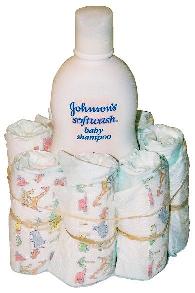 Unfold 17 of them and, one at a time, roll them up tight, starting from the front of the diaper and rolling it to the back. The tighter the better. Place a rubber band around the center after you roll each diaper up to hold it tight. These are the inner diapers for the cake.
Take the cake platter and place the 8-oz baby bottle or large bottle of baby lotion in the center. Then place about 5-6 diapers around the bottle and put a large rubberband around the entire ring of diapers.The picture to the right is what your cake will look like at this point:
Next, form a 2nd ring with the remaining 11-12 diapers by placing them around the 1st ring of diapers. Complete it by placing a large rubberband around the 2nd ring.
Now for the final ring of diapers for the 1st tier: Take 18-20 diapers, unfold each one, roll them up tight like before, but instead of a rubber band around each one, tie a thin, 1/4 inch piece of ribbon around the middle around each one. Then place them around the second ring to form a 3rd ring. Now take a large, 1/2 to 1 inch wide ribbon and tie it around the entire tier to hold them all together in a circle shape.
(Note, you could use just rubberbands around each diaper for the 3rd ring if you have opaque ribbon to hold the 3rd ring together. The important part is that no rubberbands are showing when you are done.)
All right! you have made the 1st tier. Here is what it should look like:
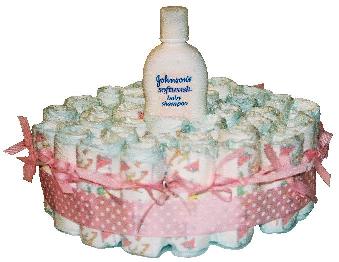
Step 3. The second tier is made much the same way, only instead of 3 rings, you will only make 2 rings of diapers. Just like the 1st tier, the inside ring will need about 5-6 diapers. Part of the 8-oz bottle will be sticking out of the 1st tier, so place your 5-6 diapers around it to form the 1st ring of the 2nd tier. The 2nd ring will need 11-12 diapers. Place a ribbon around each one of those 2nd ring diapers and hold them all together in a circle with the 1/2 to 1 inch wide ribbon, just like before.
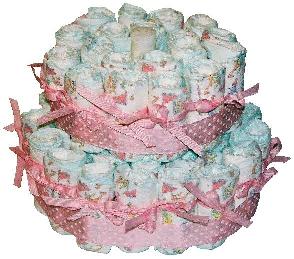
Here is what the finished 2nd tier will look like:
Step 4. Third tier is easy!
It is probably easiest to assemble this tier on a table and then place it on the rest of the cake after it is assembled. So, take a 4-oz bottle and place it on the table.
Then take 5-6 diapers and roll them up like before and tie them with the thin ribbon.
Then place them around the 4 -oz baby bottle and tie your wide ribbon around it to hold it together tightly in it's shape. Take the top tier and place it on the top.Drum roll, please! And now for the finished product...
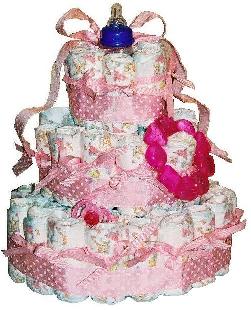
Your diaper cake will look similar to this one, with your own special twist! :]Step 5. Now for the fun part:
Add little baby items like Pacifiers, bottles, lotion, bibs, receiving blankets, miniature stuffed animals, baby towel, onesie, wash cloths, baby hygiene products, toys, etc. Place them between the folds of the diaper, tuck the larger items into the outer layer of ribbon.
Add stickers and decorations to match the baby shower theme.
Place a stuffed animal, such as Winnie the Pooh, teddy bear, Elmo, Demdaco angel, Precious Moments figurine, pair of baby shoes, or something else on top to match the baby shower theme.And Voila! You're done and it's a masterpiece! Your baby shower diaper cake is sure to receive plenty of oohs and aahs.
The picture to the right is what your cake will look like at this point:
Next, form a 2nd ring with the remaining 11-12 diapers by placing them around the 1st ring of diapers. Complete it by placing a large rubberband around the 2nd ring.
Now for the final ring of diapers for the 1st tier: Take 18-20 diapers, unfold each one, roll them up tight like before, but instead of a rubber band around each one, tie a thin, 1/4 inch piece of ribbon around the middle around each one. Then place them around the second ring to form a 3rd ring. Now take a large, 1/2 to 1 inch wide ribbon and tie it around the entire tier to hold them all together in a circle shape.
(Note, you could use just rubberbands around each diaper for the 3rd ring if you have opaque ribbon to hold the 3rd ring together. The important part is that no rubberbands are showing when you are done.)