
 Subscribe
Blog
-
Fearsome,African Mask,WE,GUERE,WARRIOR,Mask,African Art
5:16 PM PST, 2/5/2011
Superb African WE GUERE Warrior Mask Dimension 13"H x 9"W x 10"D Wood-Animal Horns Mid.20th Century Age cracks, overall condition good, Minor Wood deterioration, worn areas, chips and scrapes Stand is not Included Free Shipping U.S. *!*! This fearsome mask comes from the We people of western Ivory Coast and eastern Liberia. The We have been variously known in the past as the Kran in Liberia and the Nguere or Guere in Ivory Coast. Though close in terms of geography and culture to the well-known Dan people in the region, they are separated by language (Wee are Kru speakers and the Dan are Mande speakers). Both the Dan and We have dynamic masking associations known as Poro that initiate the young and regulate society. Poro is an exclusively men’s society, however masks between the We and their Dan neighbors are divided into male and female categories based on their form and details. -
Amazing,Kulango,Canoe,African Art
7:01 PM PST, 6/11/2009
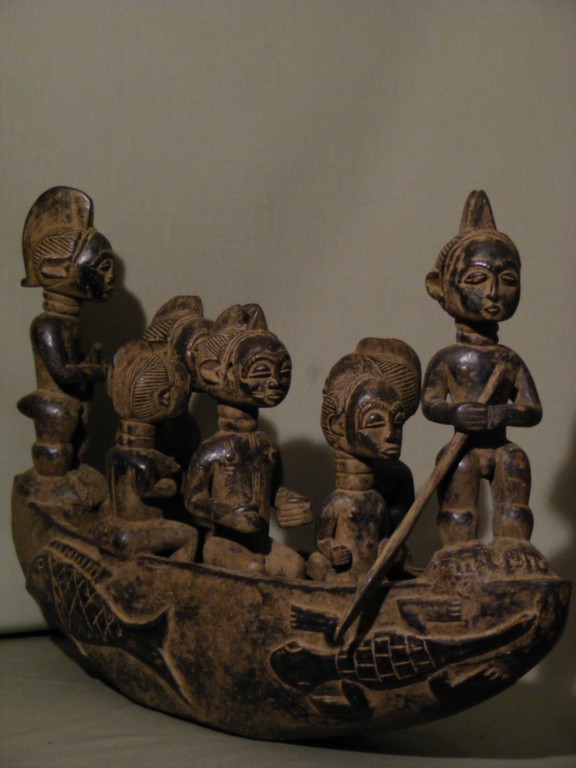
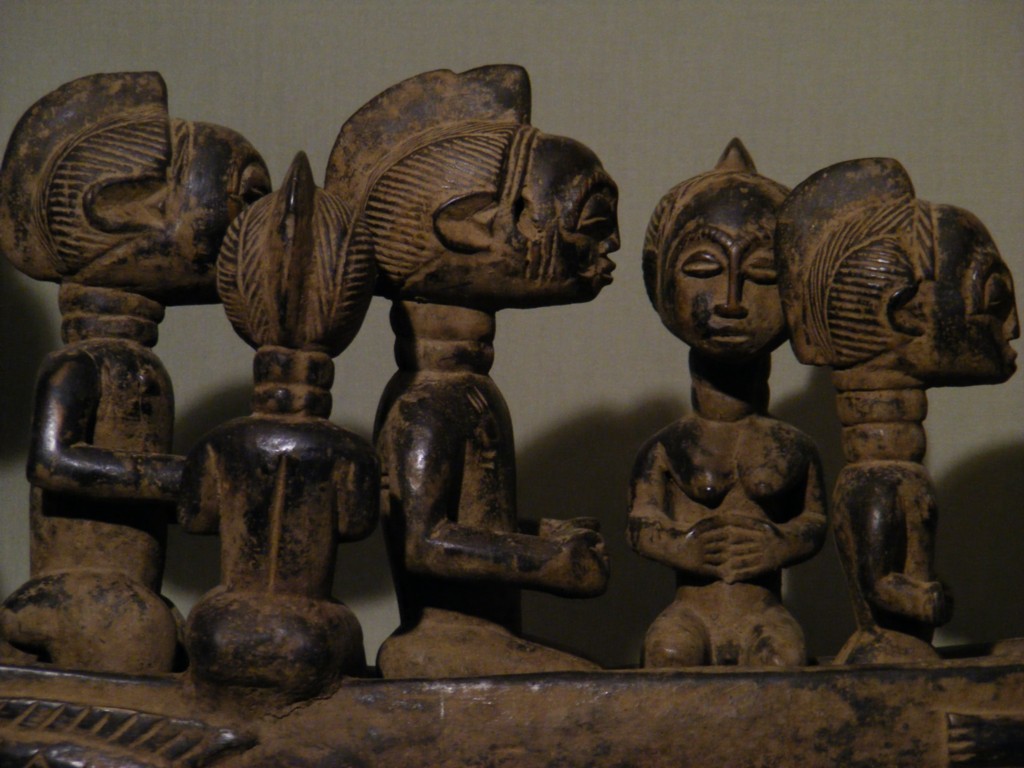
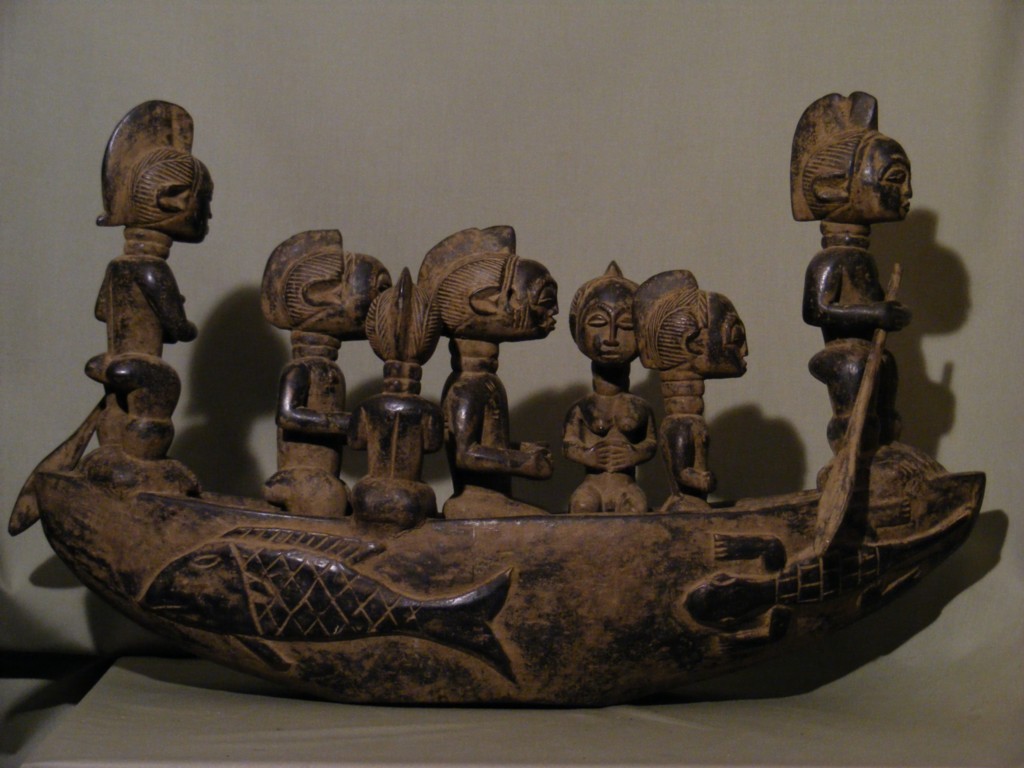
Fine Old African KULANGO Canoe
On Auction Now !!!
Dimension
15 1/2"H x 23"W x 8"D
Mid. 20th Century
Age cracks
KULANGO (KOULANGO, PAKALA)
"FREE SHIPPING U.S. "
Look Down For more Pictures
Côte d'Ivoire
The 190,000 Kulango occupy a region in the Northwest Côte d'Ivoire that borders Burkina Faso (to the north) and Ghana (to the east). The Kulango are matrilinear. They live in villages where family property is set according to lineage lines. The elders direct community life, based around the agricultural calendar. In the past, from the seventeenth century until the Mandingo invasions, a Kulango king, installed at Bouna, ruled the kingdom for better or for worse through the mediation of princely families. His power was primarily felt in Bouna, a booming center of commerce dominated by Diula merchants. Following the conquest by the Mandingo, the monarchy was significantly diminished, rebounding in a final gasp as a tool of French colonial administration. Large migrations of Akan (seventeenth century) and Lobi (nineteenth century), coming from the east and north, also destabilized Kulango cultural unity. At present, the Kulango share numerous institutions and characteristics with ethnic groups, which, in search of arable ground, have gradually come to settle in the region. The once fertile Kulango region has become almost entirely bush; therefore, the Kulango and other groups in the region are migrating southward in search of new farmland. When a man finds a plot he wishes to farm, he settles there and works until he has earned enough money to build a house for his family, who then joins him. Some of the Kulango have moved to the cities and found wage-paying jobs as mechanics, taxi drivers, or office clerks.
Each Kulango village is made up of several small settlements. The settlements consist of a number of mud huts with cone-shaped roofs made of palm leaves or thatch. The huts are grouped around a center court, which serves as a meeting place. Every settlement is made up of several extended families, each of which is its own economic unit. The male head of each extended family is responsible for offering sacrifices to the ancestral spirits. He is succeeded by his oldest sister's eldest son. All disputes and community affairs are handled by the village headmen and the religious chief. Throughout the centuries, Dyula Muslim traders have come into the Kulango region with the intention of converting the locals to Islam. However, the Kulango have resisted, and today, only about 6% of them are Muslim. The majority (90%) continue to practice their traditional ethnic religions. They believe in a supreme god who is not worshipped but is addressed in association with "mother earth." The earth god, Tano, is a god of the whole tribe. There is a shrine set up for Tano, and a yearly festival is held in his honor. During disasters or hard times, the Kulango pray to the spirits of their ancestors and make offerings of mashed yams. The spirits are believed to inhabit certain wild animals as well as various objects of nature: thunder, lightning, water, etc. The Kulango celebrate many festivals, such as the annual yam festival. This is a time when parents and children exchange gifts then eat a meal of mashed yams and soup. There is also a festival for the dead, in which the gods and ancestors are asked for guidance and prosperity. Dances and singing are part of both festivals.

-
Stunning African Tribal BAGA DRUM
10:42 AM PST, 2/26/2009


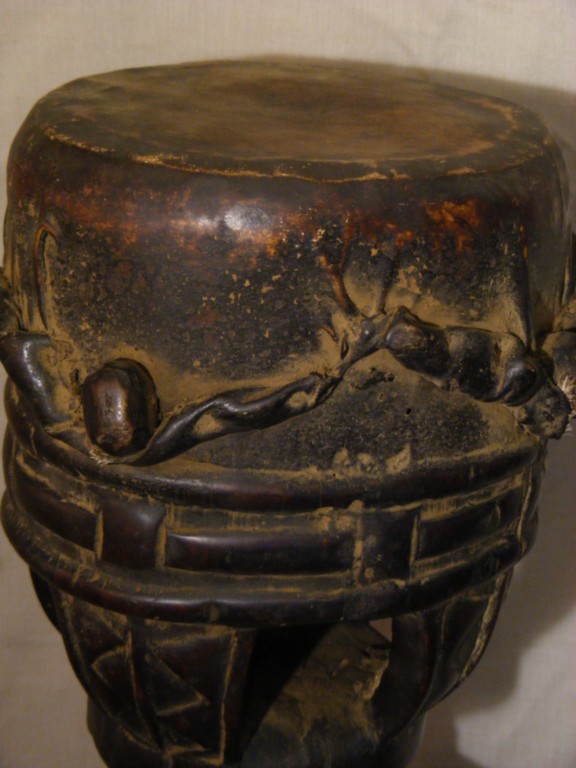

Piece On Auction Ebay
A beautiful kneeling female figure Holding a Child forms the base, four faces are at the base of the drum.
Drums such as this are some of the most revered and important objects identified with male and female initiations being played at the end of the initiation ritual. Drums used in male initiation are known as Timba. They are immense and exceptionally tall. to reach the drumhead of a Timba drum, the player would need to stand on a stool or upturned mortar. Drums used in female initiation are smaller and are known as A-ndef. They all have caryatid figures, animals, or geometric forms supporting the barrel of the drum.
Caryatid drums known as A-Ndef used by Baga women serve to focus their identity and solidarity and shape their rituals. Smaller than the men’s drum, a-Ndef are displayed and beaten publicly during elaborate marriage ceremonies, funerals and while accompanying dancers. The supporting female figure is often shown holding a child. Large drums were beaten only by men. Very Small ones were made by men, but commissioned and used by women, in rituals to support female solidarity. They were owned by the women's organizations, and beaten only by women.
The use of the timba was restricted to men. Beliefs about the drum operated on a number of levels: the drum was a tool that underscored the primacy of
male social institutions and their political power in an adult world. For Baga men, indeed, the main ritual occupation was the control of initiation into
adulthood, immersion in esoteric knowledge of the sacred, and the use of restricted paraphernalia. While the timba was primarily used in initiation
ceremonies, it also made appearances at weddings, funerals of high-ranking male elders and sacrifices to the ancestors, especially after the harvest. In
these contexts, the power of men was asserted through the appearance of the drum. The drums were so tall that they could be played only by standing on
a stool.A drum was one of the most important commissions an artist could receive in Baga society.
-
Senufo Mask
8:19 PM PST, 11/20/2008

These large horizontal masks, composites of several animals, were called Kponungo, or "funeral head masks". The term "Firespitter" is used by outsiders. Used by both Poro and non-Poro male societies, these helmet masks embodied an aggressive supernatural power to combat any forces that might disrupt the well-being of the community. The powerful features of antelopes, buffaloes, crocodiles, warthogs, hornbills, chameleons and humans combined to symbolize power and to recall important myths. They were used in anti-witchcraft ceremonies.
-
Makonde Mask
3:00 PM PST, 11/20/2008

The most important carving used in initiation ceremonies was the lipiko (or mapiko) mask, which was worn over the top of the head, tilted back so the wearer could look out through the mouth. The masks sometimes represent ancestral spirits, sometimes animals. The ancestors come back masked in order to express their joy at the successful achievement of initiation. Their presence is proof of the tight bonds that exist between the living and the dead. The Makonde masks may attain great expressiveness. Some are simple in form, with static concave planes; others display an organically sensed rounded style. The naturalism is exaggerated in many masks, with their full lips and receding cranium. The faces of the masks are often scarified. The Makonde have two main types of masks: helmet crests, known as lipiko, and face masks. The anthropomorphic face masks portray particular individuals or occasionally represent sickness. Design elements frequently include scarification marks, and eyebrows, lashes and coiffure made of real hair affixed with wax. The helmet masks have strong, Negroid features. Male masks have beards, female ones lip-plugs and – a travesty of the male dancer – body masks in which two breasts are depicted in the middle of the wax tattoos. The body masks celebrate the return of young men to the village after they have been initiated into adult life. The men who wear them cover their faces with a mask of a feminine face. They represent pregnant women. The feminine mask dances with great composure while a masculine mask dramatizes the pains of childbirth. An orchestra of drummers accompanies the dances. Certain masks must inspire terror in the women, who may only view their apparition with their upper body bent over and their head facing down towards the ground. Animal masks are provided with long ears and horns, and dancers in ape masks turn acrobatic somersaults.
Come Visit My stores!!!!
www.amazingspcychicreading.com
-
Very Old Bamileke Beaded Figure,Museum Quality
8:39 PM PST, 3/25/2008
Very Fine Old Bamileke Beaded Figure "Museum Quality" Dimensions 28"H x 10"W x 10"D Age 19th Century Material Wood,Beads,Shells Great Piece!!! Bamileke Tribe The Bamileke tribe was originally from an area to the north known as Mbam. In the 17th century traders moved southward and are currently in the grasslands of western Cameroon. Today their population consists of about eight million people. Although the Bamileke are primarily farmers, they are also hunters and traders. Women are responsible for planting and harvesting due to the belief that women make the soil more fruitful. The major crops grown are yams, peanuts, and maize. The men in the tribe help with clearing the land and hunting. The Bamileke tribe worships a supreme god and their ancestors. Ancestral spirits are embodied in the skulls of deceased ancestors. Skulls of ancestors are kept to give the spirits a place to reside to prevent them from causing trouble for the family. If a skull is not kept a ceremony must be done to compensate. The Bamileke tribe is governed by a village chief who is supported by a council of elders. In the past, the chief was believed to have supernatural powers that allowed him to turn into an animal (elephant, buffalo, or leopard). The chief is responsible for the protection of his people, dispensing supreme justice, and ensuring the fertility of the crops and fields. Many of the art produced by the Bamileke tribe associated with royal ceremonies. Most Bamileke statues represent the chief. Art objects showed the position of a person it the hierarchy. As a person descended or ascended the social ladder the materials used and the number of pieces changed. In a chief’s residence one would find ancestral figures and masks, as well as headdresses, bracelets, beaded thrones, pipes, necklaces, swords, horns, fans, elephant tusks, leopard skins, terracotta pots, and dishware. All of this was used to assert the chief’s power. Beadwork and masks are common in this tribe. Masks were decorated with copper, cowrie shells, and beads. They were carved to represent male and female heads, stag, buffalo, birds, and elephant. The elephant masks and the buffalo masks represented power and strength. Bamileke masks were usually worn during ceremonies and rituals such as funerals and annual festivals. The art styles of the grassland tribes are had to differentiate because of the complex migration patterns of the region. Bamileke masquerader with a beaded Leopard crest. In the Bamileke, the Kuosi society, who reports directly to the king, is responsible for dramatic masquerading displays. This was formerly a warrior society, whose members today are made up of powerful, wealthy men. Even the king may don a mask for an appearance at a Kuosi celebration which is a public dance held every other year as a display of the kingdom's wealth. In the image to the left, you see the Kuosi masqueraders with their beaded elephant masks and feathered headressses. These feathered headresses were also worn by themselves with a cloth costume. The Kuosi society masks can resemble elephants or leopards, both of which are royal animals. While Bamileke masks and masqueraders may appear in royal festivals, they are normally associated with various men's societies, most of which are ultimately linked to the palace and the King. The societies are closed to outsiders, and only those who have the authrization to partake in the various activities may do so. Each society has its own special house, its own masks, costumes, dances and a secret language, and acting on behalf of the king to establish order and to preserve social and religious structures of the kingdom. We ship worldwide Contact seller for more info. Check my other items!!!